



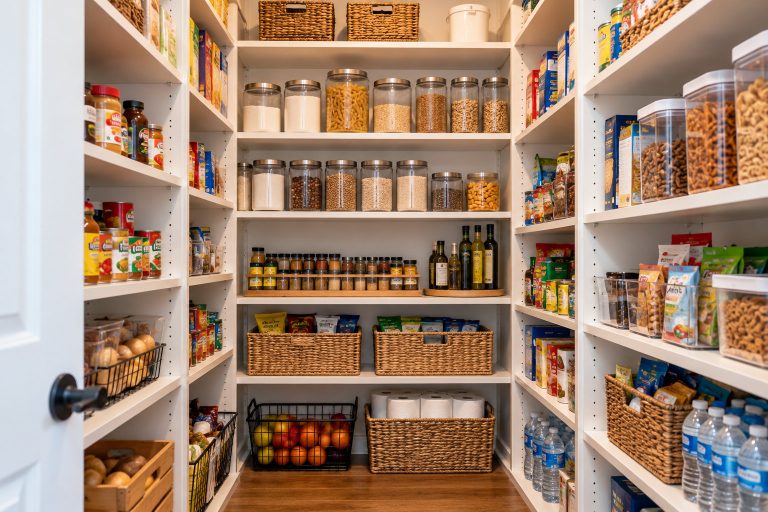
One way corporations lose money is through spoilage or food waste. That’s where supply chain and inventory management become key to a company’s success. So, when you apply this concept to managing your household pantry, buying in bulk often creates an illusion of cost savings. That’s because the upfront unit discount eventually gets diminished by spoilage.
Did you know that household food waste accounts for 40% to 50% of all food wasted in the U.S.? That’s about 26.5 million tons of food waste every year. By improving how you organize your grocery shopping and pantry inventory, the average American family can save thousands of dollars a year.
Here, I’ll guide you through treating your household food purchasing like corporate inventory management. I’ll explain how to calculate your food waste costs, when it’s ideal to buy in bulk, and how to determine your real cost per serving.
Using Your Pantry as a Supply Chain
When you go to Costco, you may be tempted to buy in bulk, thinking you’re saving money. Before you grab the large package, calculate your maximum allowable waste. For instance, if a product has a 25% discount in bulk, you must not waste more than that amount to break even with the non-bulk price.
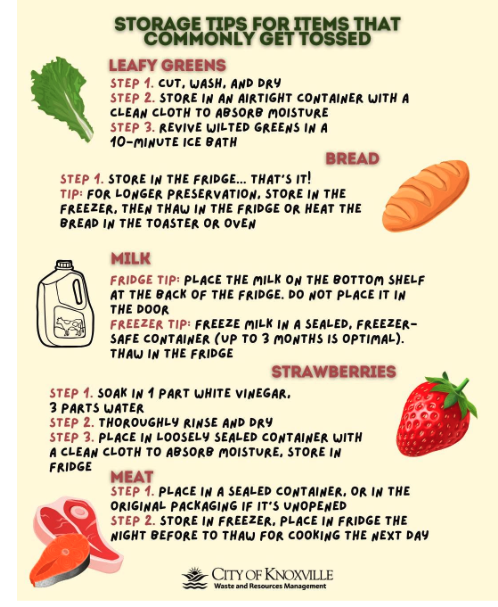
Depending on the food item, perishability can vary widely. For example, fresh berries, leafy greens, dairy, eggs, and seafood are highly perishable items. In contrast, pasta, grains, dried fruit, nuts, spreads, and canned food have a longer shelf life. Find out how long items can last in the fridge. You can download this Cold Food Storage Chart.
To optimize operations, corporations use Just-In-Time inventory management. You can use the same strategy: buy items in small quantities, in the exact amounts you’ll need, to reach 0% food waste. Some people enjoy different methods of cutting their food waste. For example, canning, dehydrating, fermenting, or pickling foods can be a great way to preserve your food. You can always experiment with different recipes in your kitchen to see what you like best.
This summer, I bought a fresh basil plant. As autumn approached, I decided to remove the basil leaves and make homemade pesto. Then I put them in a silicone cube tray and popped them in the freezer. So, if I’m ever in a time crunch, I know I can whip up a delicious pesto pasta for dinner.
How you store your food can make a big difference in how long it lasts. From a business perspective, they use Capital Expenditure (known as CapEx) to extend the shelf life of their goods. You can apply this concept by using airtight storage containers, mason jars, vacuum sealers, and deep freezers. How does this work exactly? Think of it this way: if you spend $80 on a vacuum sealer that cuts poultry spoilage from 20% to 0%, your equipment will eventually break even, and you’ll earn a return on investment (ROI) after a certain number of inventory cycles.
The Cost of Food Waste
I’ll walk you through this scenario to show how much you’re actually paying based on your consumption. To illustrate, let’s say the baseline cost is $4.00 per pound (lb) for chicken wings at the grocery store.
| Metric | Non-Bulk Option | Bulk Option | Quantity Consumed (Bulk) |
| Total Weight Purchased | 5 lbs (multiple small batch purchases) | 5 lbs (a one-time bulk purchase) | 4 lbs eaten |
| Price Per Pound | $4.00 / lb | $3.00 / lb | N/A |
| Total Upfront Cost | $20.00 | $15.00 | $15.00 |
| Spoilage Rate | 0% | 0% | 20% (1 lb wasted) |
| Actual Cost Per Pound Consumed | $4.00 / lb | $3.00 / lb (nominal) | $3.75 / lb (realized) |
The Formula For Realized Unit Cost
Most consumers overlook the cost of food waste. So, here’s the breakdown to determine the actual unit cost based on your consumption of chicken wings:
First, calculate the bulk discount:
Standard retail price: $4.00/lb
Bulk discount: 25%
Bulk price: $4.00 x (1 – 0.25) = $3.00/lb
Second, determine the amount wasted:
Total purchase: 5 lbs
Spoilage rate: 20%
Amount wasted: 5 x 20% = 1 lb
Amount eaten: 5 – 1= 4 lb
Third, find out the realized cost per pound eaten:
You paid $15.00 for the full 5-lb purchase of chicken wings, but ate only 4 lbs:
Realized Cost = The Total Amount Spent / (Total Purchased Weight x (1 – Spoilage Rate))
$15 / (5x 0.80) = $3.75/lb
With a 25% bulk discount and a 20% spoilage rate, the realized cost rises from $3.00 to $3.75 per pound eaten.
Find Your Bulk Buy Break-Even Point
Although the purchase remains cheaper than the $4.00/lb retail option, food waste eats into your savings. Let’s see how much of the expected savings the 20% spoilage rate eats away at.
Start by calculating the expected savings with zero waste
Non-bulk price: $4.00/lb
Bulk price: $3.00/lb
Expected savings: $4.00 – $3.00 = $1.00/lb
Next, find the actual savings after spoilage
Bulk purchase cost: $15.00
Quantity consumed: 4 lbs
Realized cost: $15 / 4 = $3.75/lb
Actual savings: $4.00 – $3.75 = $0.25/lb
Last, figure out the percentage of expected savings lost
Formula: (Expected savings – Actual savings / Expected savings) x 100
($1.00 – $0.25 / $1.00) x 100
= 75%
Food waste eroded the expected savings by 75%. Although the bulk purchase offered a 25% upfront discount, wasting 20% of the food reduced the expected dollar savings by 75%. In the end, you still save $0.25 per pound consumed compared to if you were to choose the small, non-bulk alternative.
Therefore, the break-even spoilage rate is 25%. That means that when you eat 3.75 lbs of chicken wings, your realized cost is $15.00 / 3.75 lbs = $4.00/lb, which equals the non-bulk price. However, if you go above the 25% spoilage rate, the bulk purchase becomes more costly.
You can experiment with this Bulk Purchase Break-Even Calculator to see how much you’re realistically saving after factoring in food waste.
Calculate Your Cost Per Serving
Let’s take it a step further and find the cost per serving. Here, we’ll assume 1 pound makes 2 servings. You can get 10 servings by buying 5 pounds of chicken wings.
Non-bulk option:
5lbs purchased x 2 servings per pound = 10 servings.
There is 0% spoilage. So, you eat all 10 servings.
$20 / 10 = $2.00/serving
Bulk option:
5 lbs purchased x 2 servings per pound = 10 potential servings.
With 20% spoilage, you lose 2 servings and consume 8 servings.
$15 / 8 = $1.87/serving
$2.00 – $1.875 = $0.125 savings per serving.
Thus, the bulk purchase saves 12.5 cents per serving, or 6.25% after factoring in food waste.
To find out the percentage saved: divide the savings by the original non-bulk cost, then multiply by 100.
($0.125 / $2.00) x 100 = 6.25% saved
To recap, you originally expected to save 25% by purchasing chicken wings in bulk. However, with 20% spoilage, you’re really only saving 6.25% compared with the non-bulk option. So, food waste has wiped out 75% of your expected savings.
How We Organize Our Food Storage
In our household, we keep a freezer inventory and a meal-planning worksheet, which you can download here. I update it every week when I buy my groceries online. Occasionally, when I cook meals or bake muffins, I make extra batches and freeze them. I also like to have cut vegetables and fresh berries in the freezer. It makes it easy when I want to make a smoothie.
Most of the time, I only buy what I will consume for the week. I buy meat in bulk when I’ve prepared meals in freezer bags that I can defrost and put into my Instant Pot.
For canned goods or perishable items, we follow the FIFO (first-in, first-out) system. I check the best-before dates on the meats and seafood I buy so I can plan meals accordingly. Hopefully, these tips will inspire you to manage your household groceries and pantry better.
Our articles provide information purely for educational purposes and do not constitute financial, tax or investment advice. You should always consult with professionals like licensed financial advisors or accountants before making any decisions. We aim to provide up-to-date and accurate information, but we make no guarantees regarding the accuracy or completeness of any content. All our examples are provided for illustrative purposes and may not reflect your personal results. We are not liable for any losses or damages arising from your reliance on the information provided.
Sources:
- https://agriculture.institute/food-microbiology-cpo/understanding-food-perishability-guide/
- https://upshop.com/what-is-just-in-time-inventory-in-grocery-retail
- https://davidsuzuki.org/living-green/seven-food-preservation-methods-to-cut-food-waste/
- https://www.marginedge.com/blog/a-restaurant-operators-guide-to-actual-vs-theoretical-food-costs-and-usage
- https://www.foodsafety.gov/food-safety-charts/cold-food-storage-charts
- https://www.nrdc.org/bio/andrea-collins/additional-research-household-food-waste
- https://wfpc.sanford.duke.edu/podcasts/insight-national-household-food-waste-study/
- https://www.foodnetwork.com/how-to/packages/help-around-the-kitchen/how-to-make-your-healthy–fresh-foods-last-longer-
