




When I learned about flexible spending accounts (FSA), I signed up immediately. It was a smart way to pay for medical expenses pre-tax. Almost like getting a coupon at the doctor’s office. But I soon realized that, as a healthy person, I didn’t visit the doctor often or have many medical expenses, so I often struggled to spend the FSA money before year-end and avoid losing it. Then along came the health savings account (HSA), which offered higher contribution limits and a way to keep your money if you didn’t spend it. I did the math and realized that switching from an FSA to an HSA was the right choice for my family. If you’re looking at your options during open enrollment this fall, here is everything you need to know, what changed for 2026, and how to calculate which one is best for you.
What is an FSA?
A Health Care Flexible Spending Account (FSA) is money you take out of your paycheck pre-tax for medical expenses. You can use it for eligible medical, dental and vision expenses. Some programs provide a debit card that you can use for these expenses, while others require you to pay these charges and submit reimbursement after the fact. You don’t need a specific health plan to have an FSA, but your employer must offer one.
For 2026, you can contribute $3,400 to your Health FSA. This is a $100 increase from 2025, when it was $3,300. The maximum contribution limit is the same for individuals as it is for families. Depending on your plan, you can roll over $680 to the following year or receive a grace period of two and a half months to use your remaining funds.
- Pros: All the money you elect at the beginning of the year is available to you right away.
- Cons: You lose money at the end of the year.
What is an HSA?
A Health Savings Account (HSA) acts similarly to an FSA, but the money doesn’t have an expiration date. You can keep the money for future expenses, even if you don’t need it all in one year. However, you must have a high-deductible health plan (HDHP) to qualify. Money contributed to an HSA provides “triple tax advantages” as long as you use it for eligible medical expenses. Contributions reduce your taxable income, investments grow tax-deferred, and withdrawals for eligible medical expenses are tax-free.
For 2026, you can contribute $4,400 to your HSA if you are the only person on your plan. If your family is covered under your health insurance, you can contribute $8,750. People age 55 and older can contribute an extra $1,000. For health insurance to be considered an HDHP, the deductible must be at least $1,700 for individuals or $3,400 for family coverage with maximum out-of-pocket responsibilities of $8,500 and $17,000, respectively.
The number of plans that qualify for HSA accounts also increases in 2026. Bronze plans and Catastrophic plans now allow you to open an HSA. Some Direct Primary Care plans no longer disqualify you from having one.
For 2027, the HSA limit increases to $4,500 for individuals and $9,000 for families covered under an HDHP.
- Pros: You won’t lose money due to expiration, and you can invest unused funds to stay ahead of inflation.
- Cons: Higher deductibles can put a strain on your finances if you have medical expenses early in the year.
FSA vs. HSA: The Key Differences
While the deductions from your paycheck look the same, your money behaves differently in an FSA than in an HSA.
| Feature | FSA | HSA |
| 2026 contribution limit | $3,400 per employee | $4,400 self-only / $8,750 family |
| Do funds expire? | Yes, beyond a $680 carryover or grace period, if offered | No, the money rolls over forever |
| Can you invest it? | No | Yes |
| Who owns it? | Your employer | You, even if you change jobs |
| Insurance requirement | None | HSA-qualified HDHP, bronze, or catastrophic plan |
| When can you use it? | Full election on day one | Only what you’ve deposited |
| Changing contributions | Only with a qualifying life event | Anytime |
If you’re thinking of leaving your job, remember that the money is owned by your employer. If you quit or are fired, you will most likely lose your FSA money, unless you choose to extend it with COBRA.
Additionally, you can only have one or the other. You cannot contribute to an HSA if you have a general-purpose Health Care FSA. However, if you have a Limited-Purpose FSA for dental and vision expenses, or a Dependent Care FSA, you can still have an HSA for medical expenses.
Why I switched to an HSA
While I used an FSA account for medical expenses for many years, when I learned about HSA benefits and ran the numbers, I switched right away during my company’s open enrollment. Here’s why.
- I was losing money at the end of the year. Any money I had over my plan’s allowed rollover amount would disappear. With an HSA, I never have to worry about spending it before the end of the year to avoid it expiring, as it does with an FSA.
- I can save more money. In 2026, individuals can contribute $1,000 more per year to an HSA than to an FSA. If you have family on your plan, you can save $5,350 more.
- My money can make me money. Money sitting in your FSA does nothing for you. However, with an HSA, you can invest it. According to Fidelity, the average 65-year-old will spend $185,500 on medical costs when they retire in 2026. That is a 7.5% increase from last year.
- I can keep my money if I leave my job. If I decide to leave my job, retire or become self-employed, I get to keep my HSA. FSA money stays with your employer, and you forfeit any unused balance when you leave.
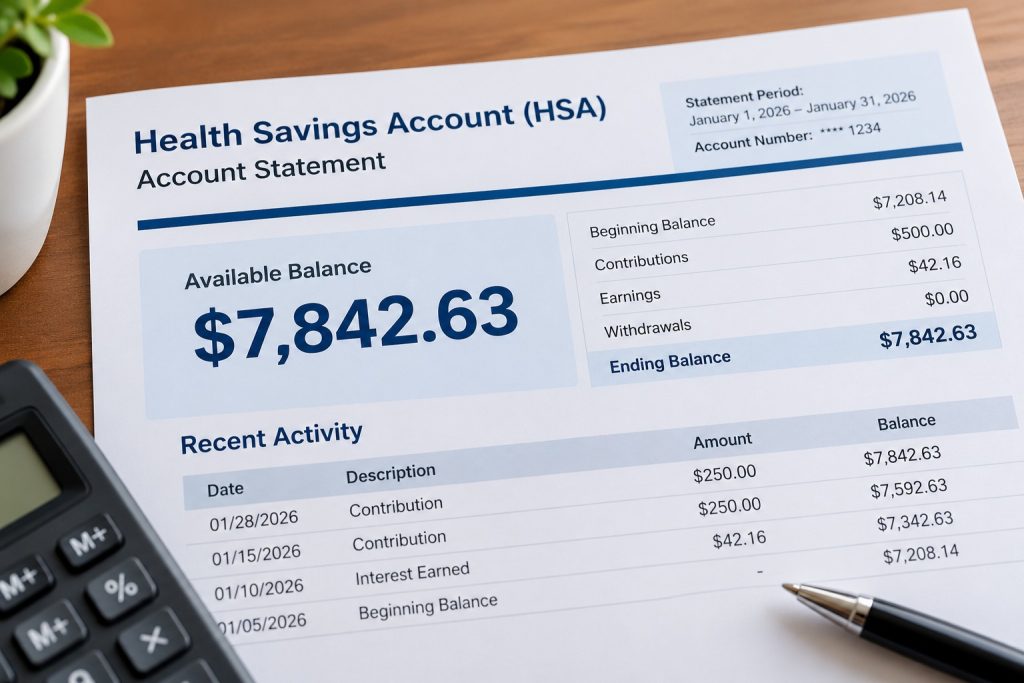
- More people are using their HSA. At the end of 2025, HSAs held $174 billion. There are 41.7 million HSA accounts, and 49% of the money is invested.
One of the best strategies I’ve heard for using an HSA is to pay your medical expenses out of pocket today while letting your HSA money grow tax-deferred. Save the receipts, and then withdraw the funds years later to reimburse yourself tax-free. This is a bit of a loophole that lets you benefit from tax-free growth in your investments. To make sure they don’t get lost, I scan my medical receipts and store them online so they’re easy to access later.
How to determine which is best for you
Here is the simple formula I used to calculate which one to pick.
- Subtract the annual HDHP premium from the PPO premium.
- Add employer HSA contribution.
- Subtract FSA contribution from HSA contribution.
Now you can compare plans and see what you will save.
Here’s a chart of our family’s healthcare costs and how we made the decision to switch from a flexible spending account to a health savings account:
| Hypothetical, self-only | PPO + FSA | HDHP + HSA |
| Annual premiums | $21,000 | $9,000 |
| Employer HSA contribution | $0 | $0 |
| Maximum contributions | $3,400 | $8,750 |
| Total premium + contribution | $24,400 | $17,750 |
By switching to an HDHP and HSA combo, we are saving over $6,000 per year. While taxes will reduce a little of those savings, the difference is real. Keep in mind that HDHP policies have higher deductibles and out-of-pocket maximums, which can eat into those savings if you have ongoing medical care or prescriptions, a major injury or illness, or other medical expenses.
When you factor in that we get to keep any unused HSA money at the end of the year, the decision is easy. If you invested $4,400 a year for 20 years at 6%, you would have around $161,900. You can’t do that with your FSA.
If you’re still unsure of which account is best for your situation, this free HSA vs FSA comparison tool gives you guidance based on your expected medical expenses, plan options available, and employment status. It also offers a free digital “shoebox” where you can store your medical receipts for future HSA reimbursement.
When an FSA is Still the Best Choice
While an HSA made sense for my family, there are times when you should use an FSA instead.
- If your employer doesn’t offer an HSA-qualified plan.
- You know you will have large expenses at the beginning of the year, such as a surgery or braces for your child. FSAs let you use your full annual contribution on Day 1, while you can only access the HSA money in the account.
- You don’t think you could pay the larger HDHP deductible if something happened to you.
Just keep in mind that if you have leftover FSA money that can roll over to the next year, or if you have a grace period, you may not be able to open your HSA until that time has passed. Ask your benefits provider for how this may affect you.
The Bottom Line
Switching from an FSA to an HSA has been a smart decision for my family. We’ve been able to contribute extra money toward future medical expenses and allow it to grow with the market without paying taxes on that income. HDHPs and HSAs are a smart way to reduce your overall medical expenses if you’re healthy and don’t spend a lot on doctor visits or prescriptions. While financial risk is higher if you get sick or injured, you can tap your HSA savings to cover unexpected expenses in one year, then switch back to a different medical insurance plan if it makes sense due to ongoing care or costly prescriptions. Review your options every year during open enrollment to determine which strategy is best for your family.
Our articles provide information purely for educational purposes and do not constitute financial, tax or investment advice. You should always consult with professionals like licensed financial advisors or accountants before making any decisions. We aim to provide up-to-date and accurate information, but we make no guarantees regarding the accuracy or completeness of any content. All our examples are provided for illustrative purposes and may not reflect your personal results. We are not liable for any losses or damages arising from your reliance on the information provided.
Sources
- FSA Feds, New 2026 Maximum Limit Updates. Published November 5, 2025.
- IRS, Treasury, IRS provide guidance on new tax benefits for health savings account participants under the One, Big, Beautiful Bill. Published December 9, 2025.
- SHRM, IRS Unveils 2027 HSA, HDHP Limits. Published May 29, 2026.
- Fidelity Investments, Fidelity Investments® Shares 25th Annual Retiree Health Care Cost Estimate, Highlighting the Importance of Incorporating Potential Health Expenses in Retirement Planning. Published July 21, 2026.
- Devenir, HSA Assets Reach Nearly $174 Billion at Year-End 2025. Published April 23, 2026.
- Motley Fool, HSA vs. FSA. Published February 13, 2026.
- Forma, Why would someone choose an FSA over an HSA? Published October 8, 2024.
