



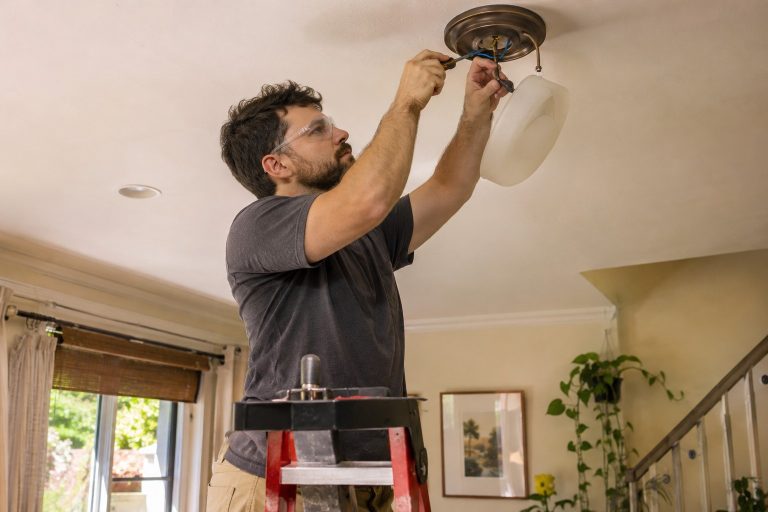
Taking care of your home requires a lot of responsibility year-round. Whether it’s oil changes, lawn care, tax filing, moving, assembling furniture, or deep cleaning, these chores can be very time-consuming. So how do you decide whether to go the DIY route or outsource to a professional?
On one hand, if you do it yourself, you take more time to complete the task but save money. On the other hand, hiring a professional saves you time and energy, but you have to spend money. According to the Home Improvement Research Institute, 44% of homeowners completed a home maintenance project in 2024. Here, I’ll walk you through an objective formula to help you determine which option is best for your situation.
The Decision Formula
First, find your hourly rate. Take your annual income and divide it by the number of hours you worked. Let’s say you earn $65,000 and divide that by 52 weeks = $1,250 per week. We’ll assume you work 40 hours per week, which makes your hourly rate $31.25 ($1,250/ 40).
If the Net Sourcing Value (NOV) is greater than zero, you should outsource the task.
Here’s the formula:
NOV = (H x R x E) – C
H = Number of hours to complete the task
R = Your hourly rate
E = The energy or burnout multiplier, on a scale of 0.1 to 2.0.
0.5 or lower: You prefer to rest to avoid burnout.
1.0: neutral and you have average energy levels.
1.5 or higher: You despise the task, and it will drain your energy.
C = Cost to hire a professional
Now let’s move on to the next section to see how this formula works.
Real-Money Scenario
Let’s say you plan to spend 4 hours on a Saturday mowing and edging the lawn.
Your time is worth $40 per hour.
Hiring a lawn mowing company costs $60 to do the work.
Let’s walk through the different scenarios.
Scenario #1: Work and Earn Money
Hours: 4
Hourly rate: $40
Energy multiplier: 1.0 (neutral)
Outsourcing cost: $60
Calculation: (4 × $40 × 1.0) − $60 = $100
You have average energy and could spend those 4 hours doing paid work instead of moving the lawn. Your time has an estimated value of $160. Since hiring someone costs only 60, you essentially have a positive outcome of being $100 ahead by outsourcing.
The decision is to outsource, as you can use those 4 hours to earn money instead.
Scenario #2: High Burnout (Rest)
Hours: 4
Hourly rate: $40
Energy multiplier: 1.5 (high burnout)
Outsourcing cost: $60
Calculation: (4 × $40 × 1.5) − $60 = $180
You’re exhausted and you really need a break. Even though you could theoretically earn $160 in those 4 hours, your energy is depleted. Keep in mind, this represents the personal value of rest, not the actual income earned. Having a professional mow your lawn lets you reclaim your weekend, get some much-needed rest, and avoid even more exhaustion.
The 1.5 multiplier increases your time’s estimated value from $160 to $240. After subtracting the $60 hiring cost, outsourcing has a net value of $180.
In this case, you’re paying for time, energy, and peace of mind, and not simply the task of lawn care.
Scenario #3: High Energy DIY
Hours: 4
Hourly rate: $40
Energy multiplier: 0.3 (enjoys mowing)
Outsourcing cost: $60
Calculation: (4 × $40 × 0.3) − $60 = −$12
You actually enjoy mowing the lawn because you get physical exercise and get to be outdoors. You find it relaxing and you don’t feel like it’s work. You’re not sacrificing valuable earning time or feeling like you need a break.
The 0.3 multiplier reduces the estimated value of those 4 hours to $48. Because hiring a professional costs $60, outsourcing would cost $12 more than the estimated value of your time.
As a result, you truly enjoy the activity and doing it yourself makes more financial sense in this scenario.
Overall, the key takeaway is that the same household chore, with the same hours, hourly rate, and outsourcing quote, can lead to three different decisions depending on your energy and circumstances.
If you want to decide whether to outsource or DIY your household chores, download this worksheet to print and fill out.

Other Factors To Consider
These are important questions you should ask yourself before making a decision:
- What tools or equipment do I need to buy to finish the task?
- How long will it take for you to learn the new skill?
- How often do you need to complete this task?
- How long will it take for you to complete the task compared to a professional?
- How much stress will this cause you if you do the job yourself?
- What happens if you make a mistake?
- What extra time should I factor in to get the job done? (Such as driving to the store to buy parts or watching DIY videos).
When To DIY vs. Outsource
It makes sense to outsource when there are safety risks involved. Anything to do with electrical, structural, gas, plumbing, roofing, or large heavy objects may be worth it to protect yourself and avoid injury.
However, sometimes hiring a professional can be costly. A simple repair like swapping a light switch or hiring a plumber to replace a leaky faucet could be pricey because contractors typically charge a minimum service fee or baseline rate.
If you run a business or side gig, you may also need to hire an accountant or tax advisor who can help you file your tax return correctly. Sometimes taxes can be complicated, and it’s better to get sound advice and file properly than to risk the Internal Revenue Service (IRS) coming after you.
Another overlooked factor is how much stress you’ll face if you decide to do it yourself. In fact, 43% of homeowners said they have increased stress related to home repairs and maintenance, based on a 2024 State of Home Spending Report by Angi. So, acknowledge your mental and physical capabilities before deciding.
How I Handle Household Tasks
There are times when we choose to hire a professional on an hourly basis and other times when we decide a task is within our comfort level and capability that we can handle on our own.
As a landlord, I recently hired a cleaning company to deep-clean our rental unit during a tenant turnover. It’s a dirty job, and it’s easier to outsource it to experienced professionals. Also, we’ve hired painters to paint our entire home. It can be costly, but for a large job, they’re much more efficient than I am. That way, it frees up my time to focus on more important priorities.
During tax season, my husband and I file our own taxes. Over the years, we’ve organized our records and have detailed files of everything. Now that we have a system in place, filing our taxes each year is easier. Occasionally, we meet with a tax advisor (a complimentary service from our fintech company) who can answer one-off questions, which helps us file our tax return confidently and accurately.
I’m also a proponent of acquiring tools to help get the task done. For instance, one time we rented a steam cleaner from a local hardware store and spent a few hours cleaning our kitchen floor tiles, bathroom floors, and area rug. At the end of the day, if you have the time and you’re willing to learn how to complete a task with care, it could be worth doing it yourself, and you might even enjoy the process!
Our articles provide information purely for educational purposes and do not constitute financial, tax or investment advice. You should always consult with professionals like licensed financial advisors or accountants before making any decisions. We aim to provide up-to-date and accurate information, but we make no guarantees regarding the accuracy or completeness of any content. All our examples are provided for illustrative purposes and may not reflect your personal results. We are not liable for any losses or damages arising from your reliance on the information provided.
Sources:
- https://lifehacker.com/do-it-yourself-or-hire-someone-use-this-calculator-to-5897130
- https://monely.app/blog/en/diy-or-hire-when-it-pays-to-do-it-yourself/
- https://decision-tools.org/decisions/diy-vs-hire
- https://madeforbuilders.com/en-US/blog/us-home-services-industry-data-2026/
- https://www.hiri.org/blog/home-services-hiring-trends-2024
- https://www.angi.com/press/angis-2025-state-of-home-spending-pulse-report
- https://www.angi.com/press/2024-state-of-home-spending-report
