



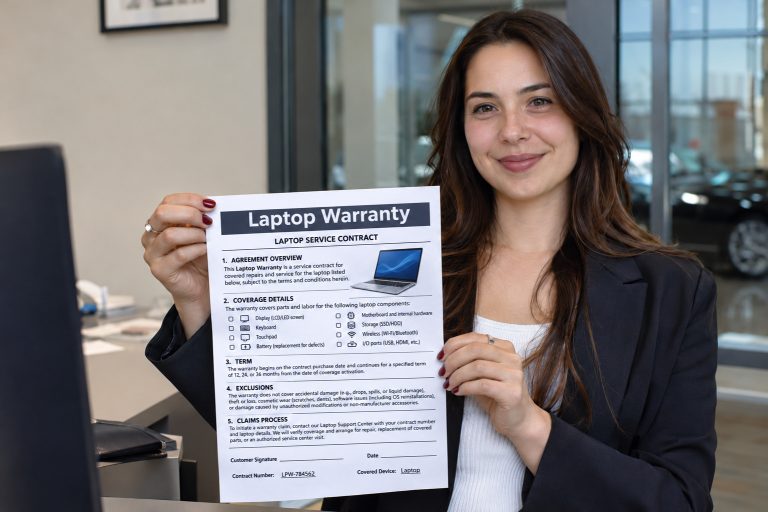
You’ve saved money in your bank account and you’re finally ready to buy a new tech device. In particular, you’re eyeing a laptop with cutting-edge technology. When you’ve finally chosen the one you want to buy, you head to the checkout line. As the cashier scans the product, they ask you if you’d like to add a protection plan for an additional $15 per month. So, how exactly do you decide on the spot? For some, it may feel like a coin toss.
On the surface, it seems like a reasonable cost to protect your new laptop. After all, you never know when your laptop may break down. If you have to pay out of pocket to repair or replace it, it could hurt your wallet. However, before you agree to pay for extra coverage, it’s a good opportunity to evaluate if you’re better off keeping that money in a bank account for potential future repairs.
Now, extended warranties can protect against faulty parts or poor craftsmanship. Despite this, they’re not always worth the extra fee. Why’s that? Well, when you review your manufacturer warranty, credit card benefits, and personal savings, you may actually have alternatives you can use instead of automatically relying on third-party coverage.
Types Of Extended Warranties And Protection Plans
Remember, not all extended warranties and protection plans are created equal. Some providers may cover mechanical or electrical breakdowns. However, some plans may have exclusions or have reimbursement limits. Let’s review the differences between the three main types.
The first is a manufacturer warranty, which is normally included with your purchase. It covers certain defects or product failures for a set period (like one to two years). Next is the retailer protection plan. It’s an extra paid service contract that could extend the coverage or include accidental damage protection.
Credit card protection is the third type. Certain American credit cards offer complimentary purchase protection or extend the manufacturer’s warranty when you pay with the eligible credit card. For instance, the Capital One Venture X credit card provides extended warranty coverage. You can check your credit card’s agreement to review the terms and conditions to find out what’s included.
Keep in mind that purchase protection and extended warranty are two separate things. On one hand, purchase protection usually covers accidental damage, spills, cracks, or internal hardware malfunctions. Extended warranty protection, on the other hand, typically covers specific product defects or hardware component failures after the manufacturer’s warranty ends.
The moral of the story is to be sure to verify which protection you may already have, as you don’t want to end up paying double for the same types of protection.
Real Money Scenario: $15/Month Over 5 Years
Let’s go through an example together to see how the numbers work. In this example, we’re reallocating $15 per month from standard protection plans, totaling $180 per year ($15 x 12 months).
Instead of paying for extended warranties, we’ll go ahead and deposit that money into a high-yield savings account (HYSA) earning 4.5% annual percentage yield (APY).
Over the period of five years, the contributions total $900 ($180 x 5).
Plus there’s an additional $104.88 earned in interest, bringing the tech replacement fund to about $1,004.88.
Note: This assumes no major technology replacement expenses during these five years and a consistent 4.5% APY.
The table below shows multi-year tracking based on this strategy to compare the two options:
| Timeline | Cumulative Warranty Cost | Tech Replacement Fund Balance (4.5% APY) | Net Benefit |
| Year 1 | $180.00 | $183.68 | +$3.68 |
| Year 2 | $360.00 | $375.63 | +$15.63 |
| Year 3 | $540.00 | $576.22 | +$36.22 |
| Year 4 | $720.00 | $785.83 | +$65.83 |
| Year 5 | $900.00 | $1,004.88 | +$104.88 |
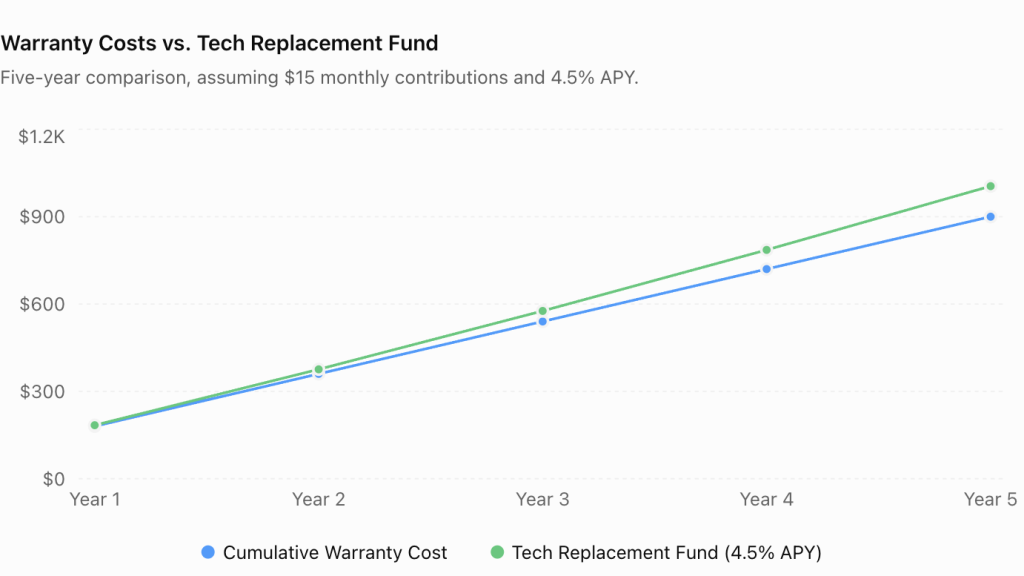
As you can see, in this scenario, putting the money into a HYSA that earns compound interest makes more financial sense and you can utilize arbitrage. By the end of year 5, the tech replacement fund had grown to $1,004.88. Ultimately, that’s $104.88 more than the $900 spent on cumulative warranty costs. This additional amount represents the interest earned while keeping the money in your own savings account.

Deciding If Buying A Protection Plan Is Worth It
Wouldn’t it be nice if we all had a crystal ball to predict if we needed extended warranty or added protection? According to the AmTrust 2025 Warranty Survey Report, 61% believe a purchase of $500 or more is large enough to justify buying a warranty. Furthermore, 53% regretted not having extended warranty coverage in the past.
In contrast, Consumer Reports analyzed more than 36,000 laptops purchased between 2013 and 2018. They discovered that only 15% of PC laptop owners and 7% of Apple laptop owners used their extended coverage for repairs. The median warranty cost was comparable to, or higher than, the median repair cost.
In some situations, I think additional coverage could make sense. For example, some parts or potential repairs can be quite costly, so having coverage may be worthwhile. If you travel extensively (whether for leisure or work) and bring your laptop or smartphone everywhere you go, coverage that includes accidental damage could be beneficial.
According to research by Empower, 37% of Americans say they can’t afford an emergency expense over $400. Given this statistic, it could be a good reason to buy protection if you fall into this category and don’t have much savings set aside, and an unexpected $500 or $1,000 bill to replace or repair your device could cause financial strain. Also, if you can get extensive coverage with low deductibles, practical replacement perks, or reasonable terms, then it may be worth paying for the plan and having peace of mind that you’re covered.
Do your research and review what is covered and what’s not so you understand how you’re protected. That way you don’t feel obligated or pressured to opt into a plan just because it’s offered at (the in-store or online) checkout.
A Simple Checklist Before Buying An Extended Warranty
Making a decision to buy additional coverage for your new gadget can be a tough decision. To make it easier for you to figure out if you need to purchase additional coverage, ask yourself the following questions:
- How long does the manufacturer’s original warranty last?
- How many months are left on the original manufacturer warranty?
- Have I shopped for manufacturer and third-party warranties and compared them?
- Does my existing credit card offer purchase protection or extended warranty benefits?
- Does the plan include accidental damage, mechanical failure, or both?
- Are there any hidden costs such as deductibles, service charges, or claim limits?
- What’s the standard repair or replacement cost of the product?
- Would I be comfortable paying for an unexpected repair out of pocket?
All in all, if the protection plan costs almost the same as the potential repair or overlaps with what you already have, keeping the money in a savings account may be a wiser choice.
My Opinion With Extended Warranties
Personally, I normally decline any protection plan or extended warranty on a product. When I’m buying a new appliance or tech gadget, I do thorough research on various brands and watch videos to see how reliable they are. On top of that, I check customer reviews online and read online forums. Then, I choose the product that is durable and will (hopefully, cross my fingers) last a long time. Now, I understand that sometimes a tool breaking down can be out of our control. So I accept the risk that if I ever need to repair or replace the item, I will end up paying out of pocket.
When I Bought Extended Warranty On A Fridge
There was a time when the fridge in my rental unit kept breaking down. After the manufacturer’s warranty expired after two years, I had to pay out of pocket to hire a technician to investigate the problem, buy replacement parts, and install them. When I spoke to the customer service representative on the phone, the estimated costs would have been greater than the extended warranty plan. So I chose the extended warranty plan for an additional two years.
I believe I got my money’s worth, but I had to call a technician to service the fridge several times before it was finally resolved. Since then, it’s been functioning normally (knock on wood). However, if it breaks down again, I’ll likely buy a new fridge, since it makes more financial sense to put the money toward a new one than to repair an old fridge that’s probably a lemon.
Sources:
- https://www.investor.gov/financial-tools-calculators/calculators/compound-interest-calculator
- https://www.nerdwallet.com/banking/best/high-yield-online-savings-accounts
- https://www.consumerreports.org/extended-warranties/extended-warranty-for-laptop-should-you-buy/
- https://www.warrantyweek.com/archive/ww20260416.html
- https://amtrustfinancial.com/getmedia/4dcb4ccd-3ecb-4205-b13f-e740f3a76e17/2025-Warranty-Survey-Report_MKT6412.pdf
- https://www.cnbc.com/select/best-credit-cards-for-extended-warranty/
- https://www.capitalone.com/learn-grow/more-than-money/all-about-venture-x/
- https://amtrustfinancial.com/getmedia/4dcb4ccd-3ecb-4205-b13f-e740f3a76e17/2025-Warranty-Survey-Report_MKT6412.pdf
- https://www.empower.com/the-currency/money/over-1-in-5-americans-have-no-emergency-savings-research
