



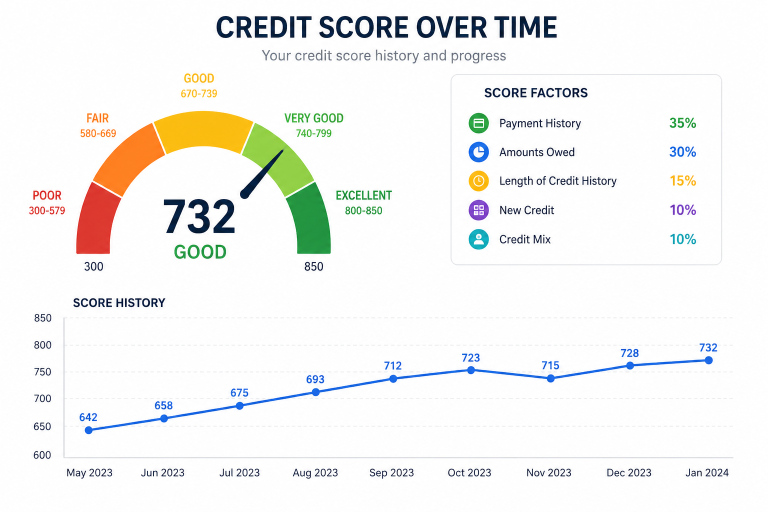
While many people don’t understand them, credit scores have a significant impact on where you work, where you live, how much you pay to borrow, and what your insurance premiums are. Having good credit is crucial if you want to save money and take control of your finances. However, this three-digit number is still a mystery to most people. Here’s how credit scores work, including the factors that go into your score, six ways to improve your credit, and alternative strategies you can count on.
What Is a Credit Score
A credit score is a three-digit number that lenders, landlords, service providers, and more use to gauge your creditworthiness. Generally, the higher your number, the more responsible you are with money and paying your bills on time. Credit scores are not a static number. In fact, they can change every time someone provides new data to the three credit bureaus – Experian, Equifax, and TransUnion.
Lenders, utility companies, courts, tax authorities and others report data to these credit bureaus to report on your financial transactions. Lenders provide your current balance, payment history, monthly payment, and other factors. Utility companies and landlords can report if you’ve missed payments or been evicted. Courts post judgments and bankruptcies, while the government documents tax liens.
A positive credit history takes time to build, while a negative mark on your credit can ruin that hard work instantly.
Who Uses It?
Credit scores are used by a variety of businesses to compare you against other consumers. Historically, credit scores have been used to determine whether your loan is approved or denied and what interest rates and terms you qualify for. More businesses are using credit scores as a way to gauge your financial responsibility before doing business with you, including cell phone providers, landlords, and insurance companies.
For some careers, a bad credit score can even prevent you from being hired. When I worked in banking, they checked my credit before offering me the job to ensure I wasn’t a risk for stealing money, taking bribes, or engaging in other criminal behaviors.
FICO vs. VantageScore
Most people don’t realize that there are actually two different types of credit scores. Each company operates its own scoring algorithm and sells its scores to lenders, landlords, and others who want to assess your financial responsibility.
FICO and VantageScore have numerous scoring models. In addition to the generic scoring model, they also offer ones specific to auto lending, credit card applications, and mortgage lending.
Credit Score Ranges
The higher your credit score, the more likely your application is to get approved. But you don’t need perfect credit to get the loan, apartment, insurance policy, or job that you’re looking for. In fact, there are different maximum credit scores and ranges when comparing FICO versus VantageScore. FICO scores range from 300 to 850, while VantageScore ranges from
| FICO | VantageScore |
| Exceptional (800-850) | Superprime (781-850) |
| Very good (740-799) | Prime (661-780) |
| Good (670-739) | |
| Fair (580-669) | Near prime (601-660) |
| Poor (300-579) | Subprime (300-600) |
As you can see, FICO breaks down scores into five categories, while VantageScore uses just four. In my experience, both as a banker and personally, if your credit score is 720 or higher (with adequate income and cash flow), you’ll qualify for almost anything you apply for. However, some loan programs and the best rates may be reserved for people with credit scores of 760 or higher.
The 5 Factors That Make Up Your Score
Since FICO is the most widely used scoring model, we’ll focus on the five factors that make up your FICO score and how much weight they have in determining your score.
Payment History (35%)
Paying your bills on time is the number one factor in your credit score. I set all of my loans and credit cards to automatic payment to ensure I am never late. Not only does it help me maintain excellent credit, but this way I also avoid late fees and penalty APRs on my accounts.
Amounts Owed / Credit Utilization (30%)
Credit bureaus reward people who use very little of their available credit. While experts typically recommend keeping your credit card balances below 30% of your credit limit, I try to keep mine under 10%. This helps to maximize your credit score.
Expert tip: You can get an extra boost in your score by paying down your credit card balance before the statement closes.
Length of Credit History (15%)
How long your accounts have been open also factors into your score. Personally, I keep several credit cards with no annual fee open, even if I don’t use them very often. Since they’ve been open for more than a decade, they help to balance out newer cards I open to earn a welcome bonus.
New Credit / Hard Inquiries (10%)
When lenders pull your credit, it is either a hard inquiry or a soft one. Soft inquiries do not affect your credit score. These are typically made when asking to increase your credit limit or for prequalification on a new account. Hard inquiries can reduce your score by up to 5 points each time one is made. However, in my experience, you can shop around for the best rates for auto loans and mortgages, yet your score is only dinged once if the inquiries happen within a short window.
Credit Mix (10%)
Lenders like to see that you have a variety of credit on your report. This shows that you can handle different types of loans while keeping your accounts paid on time. Term loans (auto loans, mortgages, and student loans) show that you can make the same payment repeatedly, while revolving credit (credit cards and lines of credit) shows that you won’t run up a large balance just because you have available credit.
The VantageScore model also uses these five factors, but in different weightings. In my experience, focusing on behaviors that improve these factors will boost your credit score, whether a lender uses FICO or VantageScore to make its decision.
6 Ways to Improve Your Credit Score
- Always pay bills on time. Set up autopay to eliminate missed payments, which can lead to late fees and negative marks on your credit.
- Lower your credit usage. Aim to keep your credit card balances under 30% of your credit limits. Below 10% is best.
- Don’t close old accounts. Keeping older accounts open preserves your average account age. I try to downgrade credit cards to versions without annual fees rather than close them to keep the accounts active.
- Be selective when applying for credit. Only apply for credit when you genuinely need it. Avoid impulse applications when checking out at retail stores.
- Build a diverse credit mix gradually. Using both revolving debt (like a credit card) and installment debt (like a car loan) can improve your score over time. However, don’t open accounts you don’t need just to diversify your credit profile.
- Monitor your credit regularly. Check your free annual credit reports at AnnualCreditReport.com. Approximately 1 in 4 consumers has an error in their credit report substantial enough to impact their score. Dispute any errors to avoid you find to avoid losing points.
What Doesn’t Affect Your Score
While credit scores are supposed to be a representation of your financial responsibility, there are many aspects of your finances that don’t affect your score. One of the biggest factors that doesn’t affect your credit score is your annual salary. While making more money makes it easier to pay bills and avoid going into debt, how much you make does not change your score. When I left my corporate job to start working for myself, my credit score did not change, even though I no longer had that guaranteed six-figure income.
Unless you use a service like Experian Boost or are sent to collections, other bills aren’t reported to credit bureaus either. For example, utility bills, insurance premiums, medical bills, childcare, and cell phone bills.
7 Alternative Ways to Build Credit
Aside from the five factors, there are other ways to build credit that you need to know about. I’ve worked with clients to use these strategies to improve credit scores quickly, as long as they’re used appropriately.
- Credit builder loans. A credit builder loan reports positive payment history as you prepay a set amount. When the loan is “paid in full,” that amount is disbursed to you.
- Retail credit cards. Store credit cards are typically the easiest to get approved for. Use the account wisely to build a positive payment history.
- Secured credit cards. With a secured credit card, your deposit sets your credit limit. After a period of responsible use, you may qualify for a higher credit limit or a return of your security deposit and conversion to an unsecured card.
- Credit builder accounts. A credit builder account allows you to pay for subscriptions to a limited number of services and pay them off in full each month. The payments are reported to credit bureaus as if you have a traditional credit card.
- Experian Boost. When activated, Experian uses non-traditional payment data to recalculate your score for free. This data may include utility bills, cell phone bills, rent, and insurance.
- Report rent payments. Landlords typically don’t report rent payments because it costs money to do so. However, you can sign up for services that report rent payments to the credit bureaus for free or a small monthly fee.
- Become an authorized user. Have someone you trust add your name to their existing credit card. You’ll benefit from their credit history on that account.
The Bottom Line
Now that you know how credit scores work, you can take steps to improve your credit and qualify for the best rates and terms on your next loan. Credit scores build over time, and errors in your credit report take time to correct. If you’re thinking about applying for a loan, start reviewing your credit report 60 to 90 days in advance. If your score is low, take steps to boost your score by paying down debt or becoming an authorized user on someone’s account.
The information provided on this website is for general informational and educational purposes only and should not be considered financial, investment, legal, or tax advice. While we strive to provide accurate and up-to-date information, we make no guarantees regarding the completeness, reliability, or accuracy of any content. Any financial decisions you make are your responsibility. You should consult with a qualified financial advisor, accountant, or other licensed professional before making decisions based on information found on this site.
Past performance is not indicative of future results. Any examples provided are for illustrative purposes only and may not reflect your individual circumstances. By using this website, you agree that we are not liable for any losses or damages arising from your reliance on the information provided.
Sources
- MyFICO, FICO® Scores Versions. Accessed May 19, 2026.
- Experian, What Is a Good Credit Score? Accessed May 19, 2026
- VantageScore, The Complete Guide to Your VantageScore 4.0 Credit Score. Published June 26, 2026.
- Federal Trade Commission, In FTC Study, Five Percent of Consumers Had Errors on Their Credit Reports That Could Result in Less Favorable Terms for Loans. Published February 11, 2013.
- Experian, What Is a VantageScore® Credit Score? Published February 9, 2026.
- Experian, Instantly raise your credit scores for free. Accessed May 20, 2026.
- Self, Build credit with a Self plan. Accessed May 20, 2026.
- MyFICO, What’s in my FICO® Scores? Accessed May 20, 2026.
- APCI Federal Credit Union, Bills That Don’t Affect Your Credit Score. Published July 24, 2024.
Experian, How Many Points Does an Inquiry Drop Your Credit Score? Published September 13, 2019.
