



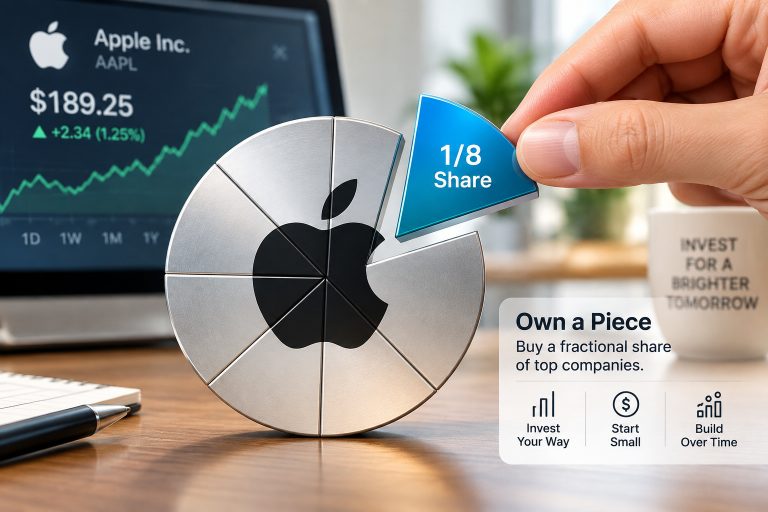
You’re interested in investing in the stock market, but you don’t have a large amount of money to start. The good news is that you can still build a DIY micro-portfolio using fractional shares.
The Global Fractional Investing Market accounted for $14.3 billion in 2025, according to the Stratistics MRC. Essentially, you get to own a slice of the pie, rather than having to buy the entire pie. You get to mimic robo-advisors without paying the management fees. Plus, you can automate tax-loss harvesting and set up a dividend reinvestment plan (DRIP).
In this article, I’ll guide you through how each feature works and how to set up your micro-portfolio so you can start building long-term wealth.
Fractional Investing vs. Robo-Advisor
Fractional investing is best suited for novice investors or those with a small budget. It’s also ideal for those who want a diversified portfolio and gain experience buying stocks by using dollar amounts instead of the full share price. One of the main benefits of fractional investing is that it’s a low barrier to entry for investors. You can use up every dollar that is in your investment account so it doesn’t sit idle.
With fractional investing, you can control the amount you buy of a single stock or ETF. Usually, it’s much more cost-effective than going with a robo-advisor. The management fees are lower compared to a robo-advisor, and many brokerages offer commission-free trading. You can also customize your micro portfolio and decide which stocks or ETFs you would like to invest in. Whereas with a robo-advisor, they have pre-set portfolios designed for you. With as little as $1, you can start buying fractional shares, compared to a robo-advisor where you usually need a minimum of $100 to start investing.
Full Shares vs. Fractional Shares
If you want to purchase fractional shares, you’ll have to go with a brokerage. If you own a full share, you typically get full voting rights. However, with fractional share ownership, your voting rights are usually restricted, or you may not have any at all. You can still receive dividends with fractional shares. They’re just prorated based on the amount you own. If you decide to switch from one brokerage to another, fractional shares are non-transferable. That means you need to sell them first and then transfer the funds over.
Tax-Loss Harvesting For Everyday Investors
Investors don’t usually want to lose money in the stock market. However, there is a way to turn it into a tax savings strategy when you file your tax return. Basically, with tax-loss harvesting, you sell a losing asset to offset capital gains or income taxes. Right after, you buy a similar asset to maintain the same portfolio allocation and stay invested in the stock market. So, if you anticipate that you’ll have realized gains, you may want to consider TLH to realize losses and offset your gains. You can deduct up to $3,000 in net losses to offset your ordinary income. Also, you have the ability to carry forward losses to future tax years.
Some brokerages can automatically do TLH for you, while others may provide the tools to scan for losses and make suggested trades. If you use an automated service, they’ll likely charge a management fee, so be sure you understand how much the costs are versus the savings. It’s a good idea to compare these features when you’re shopping around for a brokerage.
You could use this strategically when you’re rebalancing your portfolio. However, it only works in a taxable brokerage account. It doesn’t apply to registered investment accounts like IRAs or 401(k)s. Investors who are in a high tax bracket or have large realized capital gains may find this strategy valuable. In contrast, for investors in a lower tax bracket or with minimal capital gains, it may not be worthwhile.
Remember, tax-loss harvesting can be complicated. Each state has its own tax regulations and laws. So, it’s best to consult with a tax advisor or financial advisor to ensure that you’re optimizing this tax strategy and you’re complying with the Internal Revenue Service (IRS) rules.
The Wash-Sale Rule
One key aspect that you need to be aware of is the Wash-Sale Rule. It stipulates that if you sell an asset at a loss, you can’t buy the same asset or an identical asset within 30 days prior to or after the sale. Otherwise, you’ll lose the tax deduction.
Automated Dividend Reinvestments (DRIP) Explained

A Dividend Reinvestment Plan (DRIP) allows you to take your payout and immediately buy more fractional shares of the same stock, index fund, or exchange-traded fund (ETF), usually at no charge. The main benefit is that it helps to accelerate compound growth over time. Plus, it leverages dollar-cost averaging (DCA), which is where you purchase shares of a company at regular intervals regardless of whether the stock price is up or down.
Usually, dividends can be paid out monthly, quarterly, semi-annually, or annually. Keep in mind that sometimes a company may change its dividend payout amount or to stop issuing dividends completely.
How to Set Up the DRIP
For most brokers, it should be relatively easy to opt in to the DRIP. When you log into your brokerage account, navigate to the account settings. There should be a toggle switch or a checkbox to turn on the feature of automatically reinvesting dividends. For example, if you receive $25 worth of dividends, the broker will instantly buy $25 of the particular fund for you. There may be tax implications when it comes to buying more shares. So, you may want to speak with a tax professional to get advice.
I’ve set up a DRIP through my investment accounts. It’s a convenient way to automatically reinvest these funds on my behalf without having to lift a finger. Of course, you’ll need to be consistent, and over the years, you’ll be able to buy more shares and grow your wealth steadily.
FAQ
I don’t have a lot of money to start investing. Is fractional investing a good way to get started?
Yes, fractional investing may be a good place to start for beginners who have small amounts of money to invest. You can easily own shares of high-priced tech stocks, which allows you to invest right away without having to save up money to buy a full share. Plus, you can get diversification from your micro portfolio.
What’s the difference between buying a fractional share versus a full share?
A full share is a whole unit of a company’s stock, whereas a fractional share is a piece or a slice of a single share that allows you to invest a dollar amount instead of purchasing the entire unit. For stocks that are highly priced, fractional shares give investors the opportunity to get exposure and own some equity without needing a large amount of capital.
Which brokerage platforms can I choose from in the United States?
There are a variety of brokerages to choose from. Charles Schwab, Fidelity Investments, Robinhood, E*TRADE, Interactive Brokers, tastytrade, Merrill, and Vanguard are amongst the most popular platforms. Be sure to compare each platform to find the one best suited for you.
Can you tax-loss harvest in a 401(k) or IRA?
No, 401(k)s and IRAs are registered accounts with built-in tax advantages. The capital gains and losses within these accounts are not reported to the IRS.
Our articles provide information purely for educational purposes and do not constitute financial, tax or investment advice. You should always consult with professionals like licensed financial advisors or accountants before making any decisions. We aim to provide up-to-date and accurate information, but we make no guarantees regarding the accuracy or completeness of any content. All our examples are provided for illustrative purposes and may not reflect your personal results. We are not liable for any losses or damages arising from your reliance on the information provided.
Sources:
- https://www.td.com/ca/en/investing/direct-investing/articles/fractional-shares
- https://www.wealthsimple.com/en-ca/learn/fractional-shares
- https://www.schwab.com/fractional-shares-stock-slices
- https://www.fidelity.com/learning-center/smart-money/what-is-a-robo-advisor
- https://www.wealthsimple.com/en-ca/learn/what-is-tax-loss-harvesting
- https://investor.vanguard.com/investor-resources-education/taxes/offset-gains-loss-harvesting
- https://www.schwab.com/learn/story/how-dividend-reinvestment-plan-works
- https://www.investopedia.com/best-online-brokers-4587872
- https://www.nerdwallet.com/investing/best/online-brokers-for-stock-trading
- https://www.cnbc.com/select/tax-loss-harvesting/
- https://www.marketresearch.com/Stratistics-Market-Research-Consulting-v4058/Fractional-Investing-Forecasts-Global-Asset-43534364/
- https://www.irs.gov/taxtopics/tc409
- https://www.finra.org/investors/insights/investing-fractional-shares
