




Many parents dedicate countless hours enrolling their children in elite sports camps, music lessons, and private tutoring. But how many actually take the time to teach their children sound money habits? According to a survey conducted by CNBC and SurveyMonkey, 63% of Americans are living paycheck-to-paycheck. So, if we, as parents and caregivers, don’t start having these money conversations with the future generation, we won’t stand a chance of improving this statistic. Based on this information, I decided to teach my son financial literacy skills when he was three years old.
Here, I’ll share the four money skills that I’ve taught him over the past several years so you can do the same for your children.
My Childhood Experiences with Money
Growing up, I didn’t have that many opportunities to learn about money. So, as a young adult, I took the initiative and became a self-directed investor. Now, as a parent, I believe we should empower children and provide them with learning opportunities so they can make mistakes with money (while the stakes are low). They learn valuable lessons while they’re young, and it helps them build confidence. That way, they can develop money skills and apply them as they take on many financial responsibilities during their adulthood. Everything from paying off student loan debt to buying a home and saving for retirement will require them to harness their money knowledge. And it’s never too early to start teaching them the proper financial literacy skills.
Implementing Money Jars
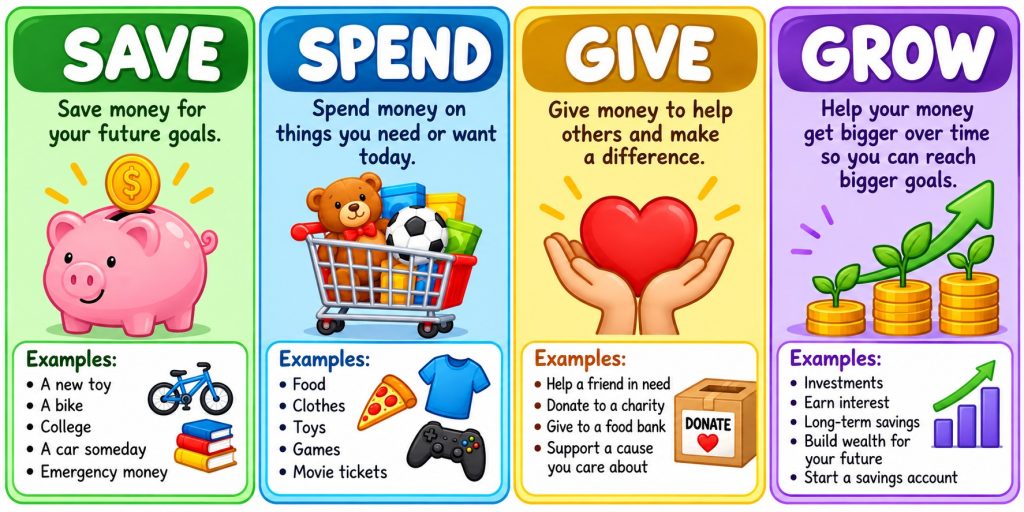
Most parents give their child a piggy bank to save money. It’s a good start. However, to see the true power of what money can do for you, I decided to create four money jars: spending, saving, giving, and growing (a.k.a. investing). These represent the four money skills kids can learn. I bought the clear plastic money jars through Amazon and labeled them.
Then I decided to give my son a weekly allowance based on his age. He began receiving an allowance when he was three years old. So, he received $3 each week. Now that he’s 5 years old, he receives $5 a week, plus a quarter ($0.25), which represents a dividend or interest earned. Using physical bills and coins makes it more tactile for kids, so they can visually see and feel how much they have. It’s also a great way for them to learn the values of each coin and bill and develop their counting skills.
I also bought the book The Four Money Bears by Mac Gardner. We read it together at home during storytime. It’s a fantastic picture book that makes it easy for young kids to understand the basic concepts of how money works, along with the pros and cons of each.
Saving Money
Just like saving money in a piggy bank, it teaches children how to stash away money for the future. Whether my son receives his weekly allowance or gets a monetary gift from his relatives during special celebrations, he diligently puts it away in his savings jar.
If my son sees a toy he wants to buy—while other parents may willingly open their wallets to buy the toy for their kids—we encourage him to save up for it. I believe it makes him value it more and not take things for granted. Because let’s be honest, most kids will buy the toy, play with it for a few weeks, and let it collect dust. So, by having him choose what he wants to save up for, he has skin in the game.
Spending Money
The second money skill is spending. Personally, I let my son choose what he wants to buy. However, I give him ground rules before we go to an event or enter a store.
For example, if we’re attending a market, we decide in advance how much money he should bring in his money pouch. Recently, he had $20 to work with; it gave him the chance to compare the price of different items or experiences. Then he ran a cost-benefit analysis. After he bought an item, he had to figure out the remaining balance and what else he could (or couldn’t) afford. Being a young kid, he often likes to buy sweet treats and toys, including rocket ships, dinosaurs, cars, and slime.
When we’re shopping at the dollar store, he points out the items he wishes to buy. We ask him to read the price, and we discuss whether it’s a need or a want. We also ask him if he already owns something similar at home (because he already has a growing collection of slime!). If it’s a high-priced item, we tell him how many weekly allowances it would take to save up to buy the product. By having these discussions, he can categorize and prioritize the items on his wish list.
Giving Money
The third money skill is teaching the importance of giving to others. We explain to our son that not all families are fortunate enough to afford necessities such as living in a home, having food on the table, or clothes to wear. Year-round, local charities or community food drives ask for donations, which allow us to have conversations with our son about giving back.
Our son has bought food items to donate to food banks, and he has donated money towards the Terry Fox Foundation. As parents, it’s important to be good role models of donating or fundraising money for important causes. As a result, we show him when Mom and Dad have donated money to charities so he understands ways to help others in need.
Growing Money
The fourth (and my favorite) way is showing our son how to grow his money. It’s a simplified term for investing. We make it relatable by using an analogy of growing a plant. We demonstrate this by giving him an extra quarter for his weekly allowance. It’s a simple way to mimic the stock market returns. Over time, he watches his grow jar accumulate money faster than the other money jars due to the power of compounding interest. Naturally, this money jar is heavier compared to the rest.
We’ve also explained to him that we have a separate digital grow jar for him, dedicated to his post-secondary education. Occasionally, I’ll show him his account balance, and he can see on the chart how the money is steadily increasing. We’re planting a seed so he understands that you have to pay tuition to earn a higher education and that we regularly set money aside to work towards this goal.
At the dinner table, we talk to him about Mom and Dad’s grow jars, which represent our retirement savings. For instance, we say that we need to work and earn money. Then we take a portion of that money and put it into our grow jars so that one day we can stop working and our retirement money can help pay for everyday expenses.
Earning Money
When our son is older, we’ll add another category for earning money. Given that I’m entrepreneurial, I’m gauging if he will follow in my footsteps someday. Since he’s still young, we’ll wait and see when there’s an opportunity for him to earn money. That may be from completing complex chores (like washing the car), selling cookies at a kidspreneur market, or buying shares of his favorite companies. It’s another money skill we look forward to teaching him so that he can learn that there are different ways to make money.
Using a Money Tracker
At home, I created a Money Tracker sheet. I printed out a hard copy and placed it onto a clipboard. You can download a copy here. Every time he receives income (allowance) or incurs an expense, he records it in his log.
For example, when he receives his weekly allowance, he writes down the date he received it, the amount, and the type of income, and draws a face to show how it makes him feel (such as happy, neutral, or sad). When he spends his money, he writes down the item he purchased, and we talk about whether his purchase was worthwhile.
I remember there was one time he bought slime, but it was low quality and didn’t last long. We talked about it afterwards, and from that experience, he learned that while it may bring about initial happiness, if the product isn’t durable and ends up breaking, it could result in disappointment later on.
I intentionally ask him about his feelings each time because I want him to make the connection between how he spends or receives money and his emotions. This practice allows him to talk about his feelings about each experience and to reflect on it. It’s a powerful way to show him that using money in different ways can bring about different feelings, so he can make better choices in the future.
Our articles provide information purely for educational purposes and do not constitute financial, tax or investment advice. You should always consult with professionals like licensed financial advisors or accountants before making any decisions. We aim to provide up-to-date and accurate information, but we make no guarantees regarding the accuracy or completeness of any content. All our examples are provided for illustrative purposes and may not reflect your personal results. We are not liable for any losses or damages arising from your reliance on the information provided.
Sources:
