



As a kid, I remember playing the classic board game Monopoly with my friends. We’d spend hours going around the board, buying properties and collecting rent from each other. Little did I know that as an adult, I’d be playing the real-life version (but with more complicated rules and real dollars).
Today, my husband and I own several condo properties where we rent out to long-term tenants. In fact, the median landlord reported having two rental properties, according to Zillow. Although we built some of our net worth through real estate, it took over a decade to achieve this. It’s taken years of hard work and financial planning to build our real estate portfolio. Just like the stock market, the supply and demand of the rental market can fluctuate too.
If you’re curious to learn what it’s like to manage real estate, follow along as I share landlord responsibilities and how to handle profit and loss (P&L) for a rental property.
The Life of a Landlord
There are plenty of ways to earn money through real estate. You could own a Real Estate Investment Trust (REIT), buy and flip houses, or become an Airbnb host. Personally, I decided to become a landlord. In the U.S., there are approximately 8.9 million landlords. As much as I still enjoy playing Monopoly, in reality, it comes with many responsibilities. Unless you own a REIT, being a landlord requires more active management. I certainly do not view it as a way to earn true passive income.
The main responsibilities of landlords in the United States are to provide a safe and clean home with running water, heat, gas, and electricity. You need to respect tenant privacy and usually give 24 to 48 hours’ notice before entering their unit. It’s important to comply with the anti-discrimination rules under the Fair Housing Act.
With wear and tear, you’ll naturally have to handle repairs promptly. In my decade of experience, I’ve dealt with all sorts of issues. At one property, I had a fridge that constantly broke down. So I had to call in a technician multiple times to diagnose the problem and install replacement parts. I’ve also dealt with flooding from another unit and had to involve property management. The thing is, these issues can arise at any time. So, you have to be proactive to resolve them.
Buying a Property
You may live in a home where you could rent out the basement apartment while you live on the upper floor. However, if you’re shopping for a rental property, there are several factors to consider.
The neighborhood plays a big role. Renters tend to favor a home that’s close to a school, shops, amenities, or modes of transportation. The type of property can range from a multiplex, townhome, bungalow, condominium, or apartment. The age of the building will determine how much maintenance it will require. Newer buildings tend to have lower maintenance costs. Over time, wear and tear will require renovations and repairs. You might choose a lower-priced fixer-upper or pay a premium for a turn-key property. Be sure to understand the rules regarding local eviction laws, rent increase guidelines, and rental regulations.
Typically, a down payment is required to purchase a property. Most homeowners will need to obtain a mortgage or a home equity line of credit (HELOC) from a lender. You’ll need to run a cash flow analysis to determine if the property price, mortgage payments, operating expenses, and the amount of rent you collect will be profitable for you over time.
I’ve bought a pre-construction condo unit in a smaller city outside of a metropolitan area. It was priced reasonably, and it would be an hour’s drive if I needed to check in on the unit. I chose a property that had different modes of transportation, local services, a college nearby, and corporate offices. I’ve been fortunate to have working professionals and post-graduate students rent out my property.
Managing Rental Income
When you become a landlord, you’ll need to keep track of your income and expenses in a spreadsheet or accounting software. You can download our rental property worksheet to organize your finances.. In the worksheet, you can enter your monthly rental income and expenses for each property. You may have other revenue sources such as renting out a parking spot, pet fees or laundry.
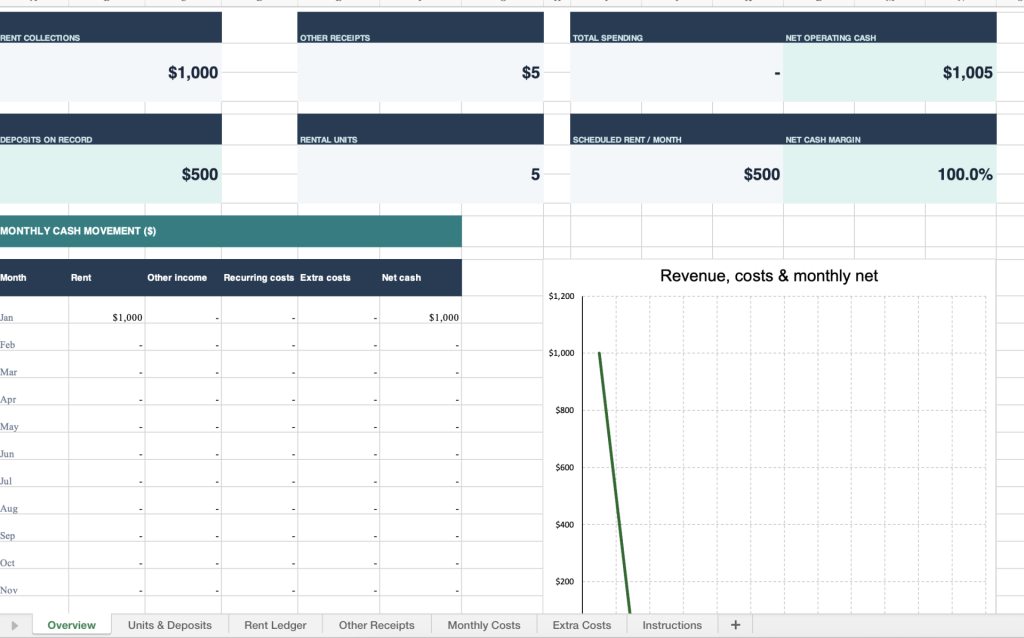
Real Estate Profit & Loss Worksheet
If you want to increase the rent, you typically have to give 30 to 90 days’ notice to the tenant. There is no federal limit on how much you can raise the rent. However, certain cities and states may have an annual cap to help stabilize rent. It’s ideal to keep a separate bank account to collect your rent payments. We also have a separate credit card for rental expenses.
Once you find a tenant and have a signed lease agreement, you’ll need to collect a security deposit. A standard lease agreement is 12 months. Alternatively, you could do month-to-month rental agreements.
In my experience, I have tenants sign a one-year lease agreement. Afterward, they can move to a month-to-month agreement. Every year, we look at comparable rental units and see the going rate for rent. Where I operate, I am capped at a 2.5% rent increase annually. For example, if I charge $2,000, I could increase it after the lease ends to $2,050 per month. I have kept the rent at the same rate so that I don’t lose my tenant. Even losing out on one month’s rent can make an impact on my rental income.
Costs of Owning a Rental Property
Once you own a rental property, there are many expenses that could be tax-deductible. The ongoing expenses include cleaning, maintenance, lawn mowing, snow removal, mortgage interest, and utilities. Operating expenses may include advertising costs, management fees, office supplies, home insurance, property taxes, plumbing, or pest control. You may incur travel expenses to collect rent or to maintain the property. You’ll need to keep detailed receipts and records of your mileage. Rental property depreciation may also be applied if you’re eligible. My husband and I have a contingency fund in case we need to pay for unexpected costs or annual increases in expenses.
When you file your taxes, you’re required to report your income and expenses from your rental property. It’s best to keep your receipts organized. I like to have physical and digital copies of my receipts in folders. My husband and I have a folder for each rental property so that things don’t get mixed up. We claim the tax deductions that we’re eligible for each year to optimize our taxes.
Nowadays, my son enjoys playing Monopoly with us. As a child, he’s learning the concept of renting and owning properties. Hopefully, when our son is older, we’ll teach him how to become a landlord so he can manage his own real estate investments.
Our articles provide information purely for educational purposes and do not constitute financial, tax or investment advice. You should always consult with professionals like licensed financial advisors or accountants before making any decisions. We aim to provide up-to-date and accurate information, but we make no guarantees regarding the accuracy or completeness of any content. All our examples are provided for illustrative purposes and may not reflect your personal results. We are not liable for any losses or damages arising from your reliance on the information provided.
Sources:
- https://www.hud.gov/helping-americans/fair-housing-act-overview
- https://www.nar.realtor/rental-properties/rental-property-tax-deductions
- https://www.investopedia.com/terms/l/landlord.asp
- https://www.zillow.com/research/typical-real-estate-investor/
- https://www.pewresearch.org/short-reads/2021/08/02/as-national-eviction-ban-expires-a-look-at-who-rents-and-who-owns-in-the-u-s/
- https://www.census.gov/newsroom/press-releases/2026/2024-rhfs-data.html
- https://www.doorloop.com/blog/landlord-statistics
- https://www.realtor.com/advice/rent/rules-on-raising-rent/
- https://www.consumer.gov/sites/www.consumer.gov/files/articles/pdf/pdf-1050g-sample_rental_agreement_basic_beginning_renting_an_apartment_or_house.pdf
- https://www.zillow.com/learn/what-are-security-deposits-for-apartments/
- https://belonghome.com/blog/accurate-rental-property-cash-flow-analysis
- https://www.irs.gov/publications/p527
