




In this uncertain economy, nobody knows where interest rates are headed. If you’re looking to lock in a higher savings rate on your money, a certificate of deposit (CD) might be the answer. CDs offer the same FDIC insurance as your checking and savings account, but their interest rates are fixed for the duration of the term selected. Most banks allow you to choose terms ranging from 30 days to five years or longer. With interest rates drifting lower and inflation staying stubbornly high, it may be a good time to put your money in a CD so you don’t have to worry about which way rates are headed. So, are CDs worth it? Here’s everything you need to know about certificates of deposit, including how they work, their pros and cons, and alternative ways to earn higher rates on your money.
What Is a CD?
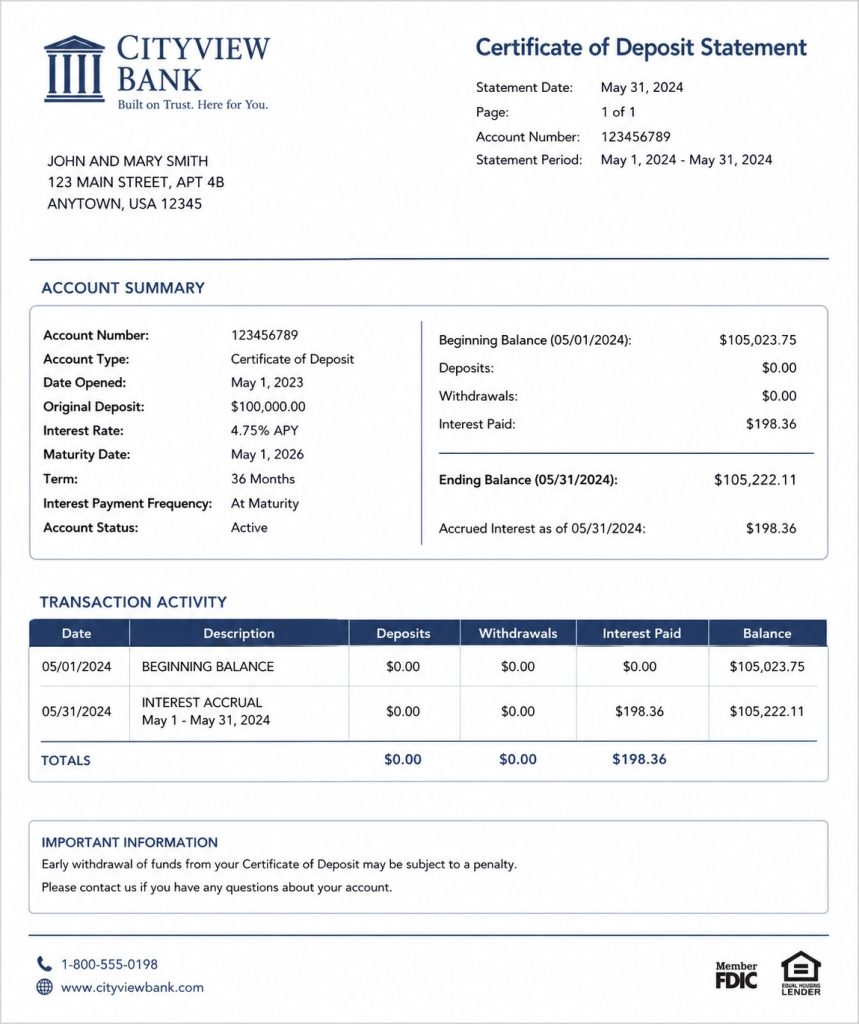
A certificate of deposit (CD) is a bank deposit account that offers a fixed interest rate for a specific timeframe. When the term expires, savers can withdraw their money without penalty, renew at current rates, change their term, or add more money to the account. However, if you need access to your money before the maturity date, you’ll pay a penalty of up to six months of interest, even if you opened the account a week ago.
Like other bank deposit accounts, CDs offer FDIC insurance up to $250,000. It is important to remember that FDIC insurance limits are based on the title of your account and cover all accounts at that bank with the same title.
Savers who want to earn a higher interest rate without taking on the risks of the stock market or bond valuations often turn to CDs. In some cases, they use a CD ladder or brokered CDs to diversify their accounts and balance earnings with access to their money.
The Benefits of CDs
- Your rate is locked. Once you open the CD, the bank can’t touch your rate even if interest rates drop.
- Higher yields than a basic savings account. CDs beat traditional savings accounts and often have higher rates than high-yield savings accounts.
- Zero market risk. FDIC or NCUA insurance means you’re not exposed to market swings the way you would be with stocks or even bond funds. Keep in mind the $250,000 limit per title at each financial institution.
- Predictable math. You know your exact payout at maturity when you open the account. This feature is useful if you’re saving toward a specific goal and target date.
- Reinvest or withdraw earnings. You can choose whether to reinvest your interest income or have your earnings deposited into a linked account.
The Downsides of CDs
- Early withdrawal penalties apply. If you pull your money out before maturity, you’ll typically forfeit three to six months of interest.
- Missing out on rising rates. The rate lock can be painful if rates climb, especially if you have a longer-term CD. Some banks offer CDs with penalty-free withdrawals, but they tend to offer lower rates than comparable term CDs.
- Inflation can quietly erode returns. High inflation can erode the spending power of your earnings, especially if inflation rises above your locked-in rate.
- Poor fit for emergency funds. With large penalties for early withdrawals, CDs aren’t the best choice for money you might need on short notice.
- Interest taxed as ordinary income. The interest earned is taxed at ordinary income rates, which can reduce the value of your earnings.
Are They Worth It Right Now?
To determine whether CDs are worth it, I advise clients to compare CD returns with other bank products. The top 1-year CDs are paying around 4.10% to 4.40% APY, which is well above the national average of 0.63% APY for savings accounts.
This means that you can earn around 3.5% more in a one-year CD than if you kept your money in a typical bank savings account. That’s a meaningful gap, and it’s the whole reason CDs are worth a look instead of parking cash in a standard bank savings account.
The Fed’s next scheduled meeting where it could move rates is September 15–16, 2026. So that date is worth watching if you’re timing your move.
Since nobody has an interest rate crystal ball, I generally recommend clients split their money between high-yield savings accounts and CDs. Using a CD-ladder strategy also provides additional liquidity while still benefiting from the higher interest rates offered to long-term CDs.
Alternatives Worth Comparing
CDs aren’t the only safe place to park cash. Depending on your timeline and tax situation, one of these CD alternatives may be a better option for your money.
High-Yield Savings Accounts (HYSAs)
An HYSA offers the same features and benefits as a traditional savings account, but they provide much higher interest rates. Their interest rates are competitive with CDs, but they don’t require you to lock up your money for a specific period of time or charge penalties if you need to access your money in a hurry. The downside is that HYSA rates are variable, so a high interest rate today can go down tomorrow. These accounts are generally available only through online banks instead of finding them at your local bank branch.
Money Market Mutual Funds
A money market mutual fund offers daily liquidity and market-driven yields. They are typically available directly from an investment company or through a brokerage account. Money market funds provide diversification and market-driven yields, making them well-suited as a flexible place to store cash that isn’t invested. However, these accounts are not protected by FDIC insurance, and some brokerage accounts may charge fees that eat into your returns.
Annuities
For savings with longer horizons, a fixed annuity offers steady returns and tax advantages. While interest rates may fluctuate, many annuities offer guaranteed returns for the first few years after opening your account. Annuities offer tax-deferred growth, so you don’t have to pay taxes on your earnings until you pull money out of the account. In exchange for these tax benefits, these funds must generally stay in the account until you reach age 59 1/2 to avoid penalties. You can withdraw money as needed or convert it into a stream of monthly retirement income, like a pension or Social Security. These accounts are worth considering if you’re looking for retirement-length timelines rather than a one-to-five-year savings goal offered by most CDs.
High-Yield Checking Accounts
Most checking accounts do not earn interest, but some online banks now pay CD-competitive rates on checking balances if you meet specific requirements. Typically, you’ll need to maintain a minimum balance, have regular direct deposits, or use your debit card a minimum number of times each month. These accounts are a solid option if you have large balances in your checking account or want to simplify your money by having just one account that earns solid interest rates.
Treasury Bonds
Treasury bonds allow you to lend money to the government at competitive interest rates. They are backed by the full faith and credit of the U.S. government, which makes them one of the safest investments globally. Treasuries carry a valuable tax perk since their interest is not taxed by state and local governments. That tax benefit can meaningfully boost your after-tax return if you live in a high-tax state. Short-term Treasuries often match or exceed CD rates, and you can sell them before maturity without penalty if you need the cash.
Treasury Inflation-Protected Securities (TIPS)
If inflation risk is your main worry with a multi-year CD, TIPS adjust their principal with inflation. This protects your purchasing power in a way a fixed-rate CD simply can’t. Interest rates are reset every six months based on current inflation reports. The minimum purchase amount is $100, and you can buy them in $100 increments directly from the government in terms of 5, 10, or 30 years.
How to Use a CD Ladder to Maximize Returns
A CD ladder solves the biggest CD complaint for savers. By laddering your CDs, you achieve periodic liquidity without giving up the higher rates that come with longer terms.
How Does a CD Ladder Work?
Instead of putting all your cash into one CD, you split it across several CDs with staggered maturity dates. For example, you can start with 1-year, 2-year, 3-year, 4-year, and 5-year term CDs in equal amounts. If you have $10,000 to deposit, each CD will be $2,000.
As each rung matures, you reinvest at the longest term to keep the ladder rolling. This not only provides an option to add or withdraw money, but it also locks in the current interest rate every cycle. After the first five years, you’ve got a full ladder of long-term CDs. Every year, one of your CDs matures, giving you regular access to a slice of your cash without ever paying an early withdrawal penalty.
CD Ladder Example
Split your $10,000 into five $2,000 CDs across each of those terms. In year one, your 12-month CD matures. This allows you to spend it, add to it, or roll the $10,000 plus interest into a new 5-year CD. The beauty of this strategy is that you’re never locked out of your money for more than a year at a time. Yet, you continue earning the higher rates that come with the longer terms in your ladder.
Other CD Options
There are other variations of CDs that allow you to access your money without penalty.
- No-penalty CDs let you withdraw early without a fee (usually at a slightly lower rate)
- Bump-up CDs let you request a rate increase once or twice during the term if rates rise. This is a good hedge against rising rates if you’re worried about locking in too early.
If you need all the money within six months, skip the CD and open up a high-yield savings account instead.
The Bottom Line
Certificates of deposit (CDs) are worth it in 2026 if you’ve got a lump sum earmarked for a goal one to five years out and you want a guaranteed rate over potentially losing money in the stock market. CD terms are fixed, and there’s a penalty if you withdraw money before the term is up. If you need flexibility, consider a high-yield savings account (HYSA) or Treasuries instead. For flexibility and higher rates, a CD ladder gives you periodic access to your cash while still locking in higher interest rates.
Our articles provide information purely for educational purposes and do not constitute financial, tax or investment advice. You should always consult with professionals like licensed financial advisors or accountants before making any decisions. We aim to provide up-to-date and accurate information, but we make no guarantees regarding the accuracy or completeness of any content. All our examples are provided for illustrative purposes and may not reflect your personal results. We are not liable for any losses or damages arising from your reliance on the information provided.
Sources
- BankRate, What is the average interest rate for savings accounts? Published July 31, 2026.
- BankRate, Current CD rates for August 2026. Published July 31, 2026.
- TreasuryDirect, Treasury Inflation-Protected Securities (TIPS). Accessed August 18, 2026
- U.S. Bank, Unlock your savings superpower with CD laddering. Accessed August 19, 2026.
- Chase Bank, What is a high-yield savings account? Accessed August 19, 2026.
- U.S. Community Credit Union. Flex Rewards Checking – A High Yield Checking Account. Accessed August 19, 2026.
