




Many working adults often wonder when they should retire and how much money they need. However, according to the U.S. Department of Labor, only about half of Americans have calculated the amount they need for retirement. If you’re not sure, you’ve come to the right place.
After all, it’s important to have the proper financial plan, so you have sufficient funds to sustain your desired lifestyle during your golden years. Typically, retirees will have a combination of
Social Security, a company pension, and income from investment accounts.
In this guide, I’ll show you the steps to begin planning your retirement. However, the earlier you start, the better. That’s because you’ll want to leverage the power of compound interest and have time to grow your wealth.
Envision Your Future Lifestyle
Have you pictured what your retirement life will look like? If not, it’s a good time to reflect on what you want to do after you step away from the workforce. Generally, expenses are lower in retirement than in your working years. You’ll want to create a budget to plan how much you expect to spend on household expenses, healthcare costs, travel, hobbies, and possibly giving money to your children or grandchildren.
Calculate Your Target Income Requirement
This is where you figure out how much money you need to stop working and enjoy retirement.
Some people might think $1 million is enough. However, the magic number is unique to you. A common formula is the 4% rule. It’s basically assuming you’ll withdraw 4% of your investments every year, which is equivalent to taking out 1/25 of your investments.
You can determine your target retirement goal by multiplying your desired yearly expenses by 25. For example, if you want to have $60,000 to spend every year, you’ll need $1.5 million to retire ($60,000 x 25 = $1.5 million).
Statistics from the CDC show that the average life expectancy in the United States is 79 years. For women, the average is 81.4 years, and for men, 76.5 years. So, if you plan to retire at age 65, you’ll want to ensure your retirement nest egg will last you about 15 years, give or take.
Determine Your Net Worth
Now that you know how much money you need to retire, the next step is to find out how much you’ve already saved. Here is where you’ll calculate your net worth. The formula is simple. Take your total assets and minus your total liabilities.
Let’s say your goal is to save $1 million. You have $400,000 in investments, real estate, and other assets. You also have $150,000 in debt, including your mortgage and loans.
Now, your net worth is $250,000 ($400,000 – $150,000 = $250,000). Therefore, you’ll need to save another $750,000 ($1 million – $250,000 = $750,000) to reach your target.
In our household, we track our net worth and update it quarterly. It’s important to have a shared vision if you have a partner or spouse. It’s a good way for both parties to know how they’re doing financially and to keep each other accountable.
Start Saving For Retirement
As a general rule, you should aim to replace 70% to 90% of your working income to continue your future lifestyle. A good starting point is saving 10% of your income. However, you’ll likely need to adjust this number based on your personal savings goal. If you’re close to reaching your retirement goal, you may not need to save as much and let compound interest do the heavy lifting. Whereas, if you’re early in your career, you may have a long way to go. So, you may need to bump up your savings rate.
Furthermore, Americans have also felt the impact of inflation in recent years. With the cost of groceries and gas going up, it means our dollar is worth less than it used to be. So, you’ll want to factor inflation into your calculations, as the cost of living will likely rise. You can use a retirement calculator to track your progress.
Understand the Social Security Benefits
Social Security is a federal program designed to provide financial assistance to retirees and disabled workers, and surviving spouses. Your retirement age and when you choose to receive Social Security benefits will determine the amount you’re eligible to receive. You can check the Social Security Administration (SSA) website to estimate your benefits. However, the longer you delay receiving your benefits, the higher the payment amounts will go.
Leverage Your Accounts
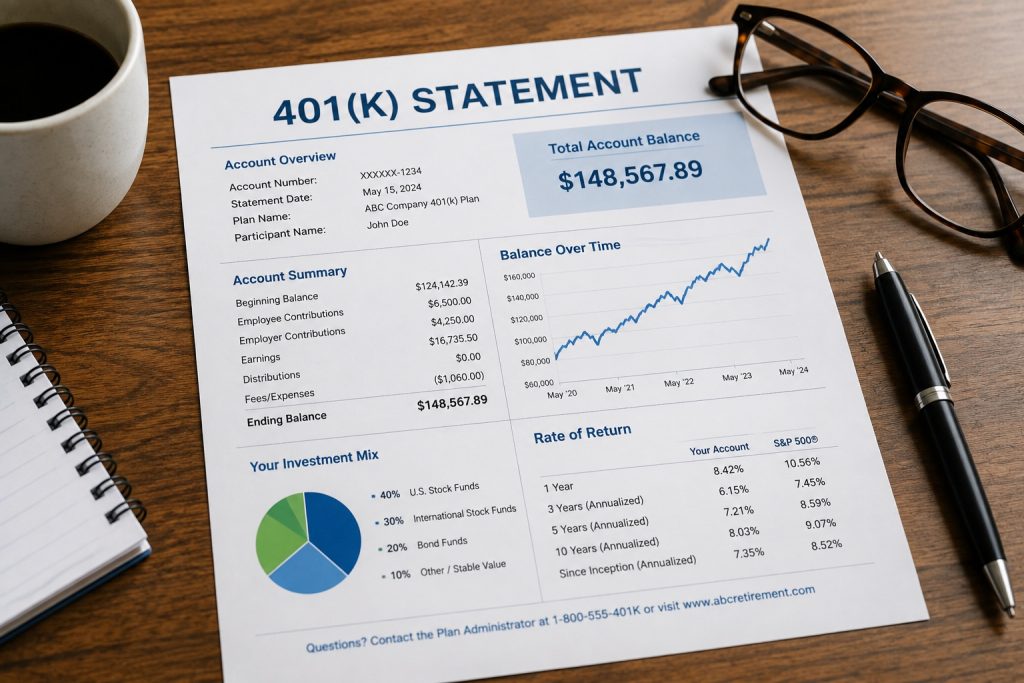
Aim to contribute regularly to your employer-sponsored retirement plans, such as a 401(k) or 403(b). It’s ideal to maximize your contributions to your Individual Retirement Accounts (IRAs) as well. Each year, the IRA determines the set contribution limit. Don’t go over the contribution limit, or else you’ll face tax penalties. Remember that you shouldn’t be touching this money until you retire.
As we age, it’s important to look after our health and well-being. Plus, healthcare costs will probably increase during retirement. Fortunately, the Health Savings Account (HSA) is a tax-advantaged account that helps you pay for your out-of-pocket medical costs and dental care. As a result, utilizing the HSA can help you take care of yourself.
Diversify Your Investments
Be strategic about what you invest in. Ensure you diversify your investments so you’re not concentrated in a single industry or geographic area. Otherwise, your investments will be too risky, and you could lose a lot of money. Ideally, you want to build an investment portfolio that is well-balanced and has a risk level that suits your investment profile.
Index funds and Exchange-Traded Funds (ETFs) could be suitable options for you to explore. You may also consider investments in government bonds, Certificates of Deposit (CDs), high-interest savings accounts, alternative investments, and real estate.
Rebalancing Your Portfolio
As you near retirement, you’ll want to rebalance your investment portfolio annually or semi-annually. When you’re closer to retirement, you’ll likely want to reduce your risk level and ensure that your funds stay safe. The last thing you want is for your investments to drop sharply right after you retire, forcing you to sell your funds at a loss. You can always seek the help of a financial advisor who can help you adjust your investments and provide you with guidance to ensure you’re on the right track.
FAQ
What’s the maximum amount I can contribute to my IRA?
In 2026, you can contribute up to $7,500. If you’re 50 and older, you can contribute up to $8,600. Also, your traditional IRA contributions may be tax-deductible. Consult the IRA website for the latest updates.
When can I start receiving Social Security benefits?
You can start receiving the benefit at 62 til 70. Deciding when to begin receiving your SS benefits is a personal choice. It also depends on whether you have other sources of income that you can rely on. If you can afford to, delaying your monthly payments will increase your benefits amount.
How can I avoid running out of money during retirement?
No one can predict how long they’ll live. So, it’s a best guess when we’re trying to determine how much we need to save for retirement. It’s a good idea to have an emergency savings fund that serves as a cash cushion. That way you don’t have to rely on expensive credit or to sell your investments at a loss.
Our articles provide information purely for educational purposes and do not constitute financial, tax or investment advice. You should always consult with professionals like licensed financial advisors or accountants before making any decisions. We aim to provide up-to-date and accurate information, but we make no guarantees regarding the accuracy or completeness of any content. All our examples are provided for illustrative purposes and may not reflect your personal results. We are not liable for any losses or damages arising from your reliance on the information provided.
Sources:
- https://legacy.trincoll.edu/retirement
- https://www.dol.gov/agencies/ebsa/about-ebsa/our-activities/resource-center/publications/top-10-ways-to-prepare-for-retirement
- https://investor.vanguard.com/investor-resources-education/retirement
- https://am.jpmorgan.com/us/en/asset-management/institutional/insights/retirement-insights/guide-to-retirement/
- https://www.ssa.gov/benefits/retirement/planner/otherthings.html
- https://www.aarp.org/money/retirement/steps-to-take-before-you-retire/
- https://www.fidelity.com/retirement/retirement-planning
- https://www.schwab.com/learn/story/retirement-planning-by-decade-savings-guide
- https://www.irs.gov/retirement-plans/plan-participant-employee/retirement-topics-ira-contribution-limits#:~:text=Note%3A%20For%20other%20retirement%20plans,taxable%20compensation%20for%20the%20year
- https://www.ssa.gov/prepare/get-benefits-estimate
- https://www.investopedia.com/terms/h/hsa.asp
- https://www.cdc.gov/nchs/fastats/life-expectancy.htm
- https://smartasset.com/retirement/what-you-need-to-know-about-retirement-income-replacement-rate
